
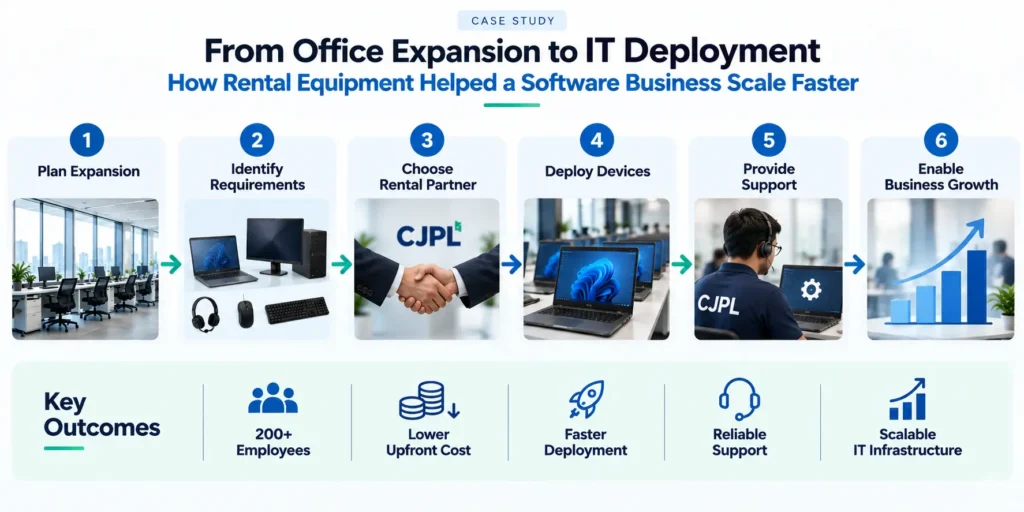
One of our clients, an IT & software company based in Mumbai, had established its operations around software development, technology consulting, and digital project delivery. The company needed access to suitable computing equipment for its technical teams while maintaining control over procurement costs and operational commitments. As employee requirements changed and project responsibilities increased, purchasing every additional device was not necessarily the most practical approach.
Our client needed an IT infrastructure partner that could understand its business requirements, provide suitable hardware configurations, and help it plan equipment availability without creating unnecessary procurement complexity.
To explore a more flexible approach, the company approached Computer Junction, an enterprise IT and mobility rental service provider offering computing equipment and technology infrastructure solutions to businesses across India.
This case study explores how the Mumbai-based software company evaluated its IT requirements, the challenges associated with conventional hardware procurement, and how Computer Junction’s IT rental solutions offered a practical approach to supporting its evolving business needs.
The Challenge: Managing Hardware Procurement, Project Deadlines, and IT Costs
One of the primary challenges faced by growing software companies is aligning technology procurement with business requirements. Hiring plans, project timelines, and client expectations do not always follow predictable schedules. A new project may require additional developers, a testing team may need temporary systems, or an organisation may need to establish a separate workspace for a specific assignment.
When businesses rely exclusively on purchasing equipment, these changes can create financial and operational pressure. For our client, additional computing requirements needed to be evaluated against the cost of acquiring new devices and the expected duration of their use. Hardware purchased for a short-term project could remain underutilised after the assignment ended, while delaying procurement could make it difficult to equip employees when they needed to begin work.
The company also had to consider the different technical requirements of its employees. Providing identical configurations to every department would not necessarily be the most efficient approach because development, testing, administration, and project management involve different workloads.
Another consideration was the responsibility associated with managing an expanding inventory of IT assets. Each additional device introduced requirements relating to allocation, maintenance, troubleshooting, tracking, and future replacement.
Our client needed a solution that could help it evaluate suitable configurations, plan equipment requirements more systematically, and access computing infrastructure without automatically making a permanent investment in every system.
These challenges prompted the company to approach Computer Junction to explore flexible IT rental solutions aligned with its operational needs.
The Solution: How Computer Junction Helped Our Client Evaluate Flexible IT Rental Options
Computer Junction provides enterprise IT rental solutions covering laptops, desktops, workstations, servers, networking devices, and other business technology equipment. Its service portfolio enables organisations to assess their infrastructure requirements according to the nature of their work and the equipment needed by different teams.
For our client, the first consideration was identifying the type and quantity of equipment required. Understanding employee responsibilities and project workloads would help determine whether standard business laptops, desktop computers, or higher-performance workstations were appropriate for particular roles.
The next consideration was configuration. Processing power, RAM, storage capacity, operating system requirements, and compatibility with business applications all influence whether a device is suitable for a software development environment.
Computer Junction’s configurable IT rental offerings provided an option for businesses to align hardware specifications with their operational requirements rather than relying on a single configuration for every employee.
The company could also evaluate rental periods according to the expected duration of its hardware requirements. This was particularly relevant for project-based work, temporary team expansion, and assignments where equipment demand might change over time.
Computer Junction’s ready inventory and quick turnaround capabilities were additional considerations for coordinating equipment availability with business schedules. Actual delivery timelines would depend on stock availability, location, configuration, and the agreed service requirements.
Configurable Hardware: Matching the Right IT Equipment to Software Development Workloads
Software development involves a wide range of technical activities, and not every employee requires the same computing capacity. Selecting appropriate hardware is therefore an important part of maintaining an efficient development environment.
Developers working on resource-intensive applications may need systems with higher memory capacity, powerful processors, and fast solid-state storage. Teams working with virtualisation, containerised applications, large datasets, or complex testing environments may have additional requirements.
Other employees, including business analysts, project coordinators, HR professionals, and administrative staff, may be able to perform their responsibilities effectively using standard business computing configurations.
Computer Junction offers configurable laptop and desktop rental options, allowing businesses to evaluate specifications based on their workloads and intended applications. This can help organisations avoid allocating expensive hardware to roles that do not require it while ensuring that technically demanding teams have access to suitable equipment.
A configuration-based approach also supports more organised procurement planning. Instead of estimating hardware requirements only by counting employees, the company can consider the applications employees use, the complexity of their work, and any specific performance requirements.
Scalability: Supporting New Projects, Employee Onboarding, and Changing Team Requirements
Software companies frequently experience changes in workforce requirements as they secure new projects, expand existing engagements, or introduce additional services. These changes can create a need for computing equipment at short notice.
For Our Client, scalability was an important consideration because the number and type of devices required could change as project responsibilities evolved. Computer Junction’s IT rental solutions offered a way to evaluate additional equipment according to changing business demand. Instead of purchasing a permanent inventory based on anticipated future growth, Our Client could assess its immediate requirements and plan additional equipment as needed.
For instance, a new development project may require additional laptops for developers, while a testing assignment may require specific desktop configurations or workstations. A temporary increase in staffing may also create a need for additional devices for a defined period.
A flexible rental arrangement can help businesses evaluate these requirements without assuming that every new hardware need must result in permanent ownership.
Computer Junction’s PAN India presence and delivery capabilities are also relevant for businesses managing requirements across multiple locations. Although Our Client’s primary operations were based in Mumbai, companies with distributed teams or additional offices can benefit from having an IT rental partner that supports equipment requirements across India.
Equipment availability, deployment schedules, and service arrangements should be confirmed for each location before finalising a requirement. For a growing software company, this approach can make hardware planning more responsive to project schedules and workforce changes while reducing the risk of maintaining unnecessary equipment.
Technical Support and Maintenance: Helping Software Teams Stay Focused on Core Work
When computing equipment develops a hardware fault, employees may experience interruptions that affect development tasks, testing schedules, and project delivery. Managing these issues internally can place additional pressure on IT teams, particularly when the organisation operates a large number of devices.
For Our Client, technical support and maintenance were important considerations when evaluating its equipment requirements. Computer Junction offers technical support arrangements for its IT rental services, with the available support depending on the equipment and agreed service terms. Such arrangements can provide businesses with a defined channel for reporting eligible hardware issues and coordinating troubleshooting or replacement where covered.
This can help reduce the need for an organisation to manage every hardware-related issue independently. It also allows internal IT teams to concentrate on other responsibilities, such as application infrastructure, network management, development environments, and security.
By considering technical support alongside equipment selection and rental costs, Our Client could evaluate a more comprehensive approach to managing its computing infrastructure.
Key Lessons for Software Companies Considering IT Equipment Rental
Our Client’s case highlights several considerations for software development companies evaluating IT equipment rental as part of their infrastructure strategy.
The first is the importance of identifying actual hardware requirements. Different roles involve different workloads, and selecting equipment according to application needs can help businesses allocate resources more effectively.
The second is the need to assess total costs rather than focusing exclusively on the initial purchase price. Maintenance, upgrades, depreciation, equipment utilisation, and replacement all influence the financial outcome of ownership, while rental agreements introduce their own recurring and contractual costs.
The third lesson is that flexibility can be valuable when employee numbers and project requirements change. Rental can offer an alternative for businesses that need additional equipment for defined periods, provided the availability and contract terms meet their requirements.
The fourth is to evaluate technical support and deployment responsibilities before finalising an arrangement. Clear expectations can help prevent confusion when hardware issues arise or equipment needs to be returned.
Finally, businesses should measure the results of their procurement decisions. Equipment utilisation, employee downtime, deployment efficiency, and overall IT expenditure provide useful indicators for evaluating whether the chosen model is meeting operational objectives.
These considerations apply not only to software development companies but also to IT services firms, startups, consulting businesses, BPOs, and enterprises managing project-based teams.
Conclusion
For a growing software company, reliable computing infrastructure is essential to maintaining development workflows, supporting employees, and meeting client expectations. However, managing hardware requirements becomes more complicated when workforce size, project schedules, and technical needs change over time.
Our Client, a Mumbai-based software company, approached Computer Junction to explore a more flexible approach to its IT infrastructure requirements. The company’s priorities included access to suitable computing equipment, financial flexibility, scalability, and a structured approach to hardware support.
Computer Junction’s enterprise IT rental solutions provided an option for evaluating these priorities through configurable laptops, desktops, workstations, servers, and related technology equipment. Its broad equipment portfolio, quick turnaround capabilities, flexible rental options, technical support arrangements, and PAN India presence are relevant considerations for businesses planning their IT requirements.

I am an accomplished author and marketing professional with strong expertise in brand promotion and digital transformation. helping businesses build powerful brand identities and expand their presence through strategic digital marketing initiatives. With hands-on experience in modern marketing tools and business digitalization.


