
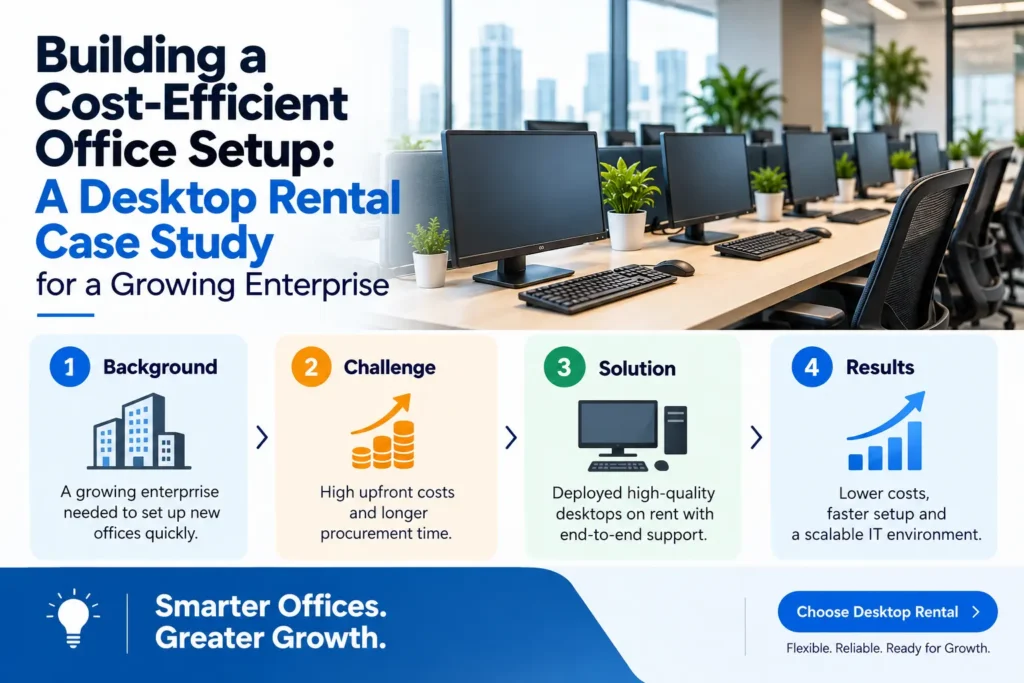
As companies expand their teams, onboard employees, and take on additional projects, they must ensure that their office infrastructure can support increasing workloads. For a growing enterprise, purchasing desktop computers for every new employee may appear to be the most straightforward approach. However, bulk hardware purchases require substantial investment, while ongoing maintenance, equipment upgrades, and replacement planning add to the total cost of ownership.
Desktop rental offers an alternative by allowing businesses to access the computing infrastructure they need without purchasing every device outright. This approach can help organisations manage cash flow, scale their workforce more efficiently, and align technology expenses with actual business requirements.
The organisation featured in this case study is an established, growing enterprise operating from South Delhi. Its business relies on office-based employees who use desktop computers for daily administrative activities, internal coordination, business documentation, customer communication, and digital workflows.
This case study examines how this reputed enterprise approached office expansion through a desktop rental model. It explores the company’s business requirements, infrastructure challenges, proposed rental strategy, implementation considerations, and the potential operational and financial benefits of choosing flexible IT equipment rental over conventional hardware procurement.
Business Challenge: Managing Office Expansion Without Heavy Desktop Procurement Costs
As the organisation planned to expand its workforce, desktop availability became an important consideration. Every additional employee required a suitable computer, and the organisation needed to ensure that its systems could handle the applications and workloads associated with each role.
Purchasing desktops in bulk could create a significant initial expense. Beyond the purchase price, the company would also need to consider monitors, keyboards, mice, operating systems, configuration, deployment, maintenance, and future replacement requirements.
Another challenge involved forecasting future demand. If the company purchased hardware for its expected maximum workforce, some devices could remain unused if hiring or project expansion progressed more slowly than anticipated. On the other hand, purchasing too few systems could delay employee onboarding and reduce operational efficiency.
The organisation also needed to consider the long-term management of its hardware inventory. As the number of desktops increased, so would the effort required to track assets, coordinate repairs, manage upgrades, and maintain consistent configurations across departments.
The objective was not simply to obtain desktops at a lower price. It was to establish an office computing environment that could support current operations, accommodate future growth, and help the business maintain better control over its technology-related expenses.
Solution Strategy: Using Desktop Rental to Establish a Flexible Enterprise Office Setup
After identifying its infrastructure requirements, the enterprise evaluated desktop rental as an alternative to purchasing all its computing equipment. Under this approach, the company obtained desktop computers for an agreed rental period, with configurations selected according to employee workloads. Depending on the rental agreement, the arrangement could also cover accessories, delivery, installation, technical support, maintenance, and equipment replacement.
The key advantage of this model is that the organisation does not need to commit the entire hardware purchase budget at the beginning of the project. Instead, it planned its computing requirements according to the office expansion schedule and expected employee strength. This would make it easier to coordinate equipment availability with recruitment and operational planning.
Desktop Configuration Planning: Matching Computer Specifications to Employee Requirements
Selecting the right desktop configuration is an important part of building a cost-efficient office environment. A computer that is suitable for one department may not provide the performance required by another.
The enterprise therefore divided its desktop requirements into suitable configuration categories. This helped to standardise equipment within departments while preserving flexibility for specialised workloads.
Desktop rental services can offer configurations across different processor generations, memory capacities, storage options, and display sizes. Businesses can review available systems and select equipment based on compatibility, performance, and budget. This approach supported better resource allocation and made it easier for IT teams to maintain consistent configurations across the office.
Implementation Plan: How Computer Junction Coordinated Desktop Delivery, Installation, and Employee Onboarding
When the growing enterprise in South Delhi approached Computer Junction, its primary concern was ensuring that employees had access to the required desktop computers without delaying office expansion or increasing the workload on its internal IT team. The company needed a dependable IT rental partner that could help coordinate hardware availability with employee onboarding schedules.
It began by understanding the enterprise’s desktop requirements, including the number of employees to be equipped, departmental computing needs, preferred deployment timelines, and essential accessories. This requirement assessment helped establish a deployment plan aligned with the company’s immediate operational priorities.
Based on the identified requirements, it helped the enterprise evaluate suitable desktop configurations for different employee roles. By offering access to ready stock, it helped address the challenge of sourcing the required equipment while keeping deployment timelines in focus. Its PAN India delivery capabilities also support businesses managing IT requirements across multiple office locations.
The deployment process involved coordinating equipment delivery with the enterprise’s expansion schedule. This helped the company plan hardware availability around employee joining dates and reduce the risk of employees waiting for essential computing equipment.
Computer Junction’s IT rental solutions also provided the enterprise with an opportunity to discuss technical support and other service requirements as part of the rental arrangement. Responsibilities relating to installation, configuration, software preparation, and ongoing support could be aligned with the agreed service scope, ensuring clarity between the enterprise and its IT rental partner.
By combining requirement assessment, coordinated delivery, and access to technical support, it helped the enterprise approach its office expansion through a more structured and manageable desktop deployment process.
Risk Management
While evaluating desktop rental, the South Delhi enterprise recognised that controlling IT expenditure was only one part of the decision. Its desktop infrastructure also needed to support information security, reliable operations, and appropriate handling of company data throughout the rental period.
Computer Junction helped the enterprise evaluate desktop rental as part of a broader IT management strategy, in which equipment requirements, technical support responsibilities, and rental conditions needed to be clearly defined.
Because office desktops may contain confidential business documents, employee information, customer records, and financial data, the enterprise needed to retain responsibility for implementing appropriate security controls. These could include operating system updates, endpoint protection, user authentication, access restrictions, and encryption where appropriate.
The company also needed a clear procedure for managing rented desktops when employees changed roles, left the organisation, or no longer required their assigned systems. Before returning any device, the enterprise would need to back up essential business information and securely remove company data in accordance with its internal policies.
Business continuity was another important consideration. Hardware issues can interrupt employee productivity, particularly when desktops are essential to daily operations. By discussing support arrangements and applicable replacement provisions with Computer Junction, the enterprise could establish a clearer process for responding to technical problems.
Its technical support capabilities and IT rental services provided a basis for planning how hardware-related issues would be managed during the rental period. The exact response timelines, replacement conditions, and service coverage would depend on the agreement between the two parties.
This structured approach helped the enterprise evaluate desktop rental beyond its immediate cost implications. By considering security, asset tracking, support arrangements, and data-handling responsibilities together, the company could plan a more reliable and accountable IT deployment.
Key Lessons: What Growing Enterprises Can Learn From Computer Junction’s Desktop Rental Approach
The experience of the South Delhi enterprise highlights several considerations for businesses exploring desktop rental to support office expansion.
First, understanding employee requirements is essential before procuring IT equipment. By approaching Computer Junction, the enterprise could assess the desktop configurations and quantities needed for different roles. This illustrates the importance of matching hardware specifications to actual workloads rather than selecting equipment without a clear understanding of business requirements.
Second, procurement decisions should consider the complete financial picture. Purchasing desktops involves more than the initial acquisition cost, while rental arrangements involve recurring charges and contractual commitments. Businesses should compare both models over the expected period of use before deciding which approach best supports their financial objectives.
Third, delivery planning can significantly influence the employee onboarding experience. Computer Junction’s ready-stock availability and PAN India delivery capabilities are relevant considerations for businesses that need to coordinate equipment deployment with office openings, new employee joining dates, or project schedules. Companies should confirm stock availability and delivery commitments before finalising their deployment plans.
Fourth, technical support and maintenance responsibilities should be defined clearly. Businesses evaluating Computer Junction’s desktop rental services should review the support scope, response arrangements, and any applicable replacement provisions to understand how hardware-related issues will be managed.
Fifth, scalability should form part of the procurement strategy. Organisations experiencing changing workforce requirements can evaluate flexible rental periods and staged equipment deployment rather than automatically purchasing a permanent inventory for every anticipated need.
Finally, performance should be measured through clear business indicators. Deployment timelines, hardware utilisation, support performance, cost per workstation, and overall IT expenditure can help organisations determine whether their chosen infrastructure model is delivering the expected value.
These lessons are relevant to startups, established enterprises, professional services firms, BPOs, training centres, and organisations preparing to open new offices or expand existing teams.
By working with an IT rental provider such as Computer Junction, businesses can evaluate their infrastructure options with greater attention to hardware requirements, deployment planning, financial considerations, and future growth.
Conclusion
Expanding an office requires more than increasing the number of computers available to employees. Businesses must coordinate hardware procurement, employee onboarding, financial planning, technical support, and future infrastructure requirements.
For the growing enterprise in South Delhi, approaching Computer Junction provided an opportunity to evaluate desktop rental as an alternative to purchasing every workstation outright. The company’s requirements centred on accessing suitable desktop configurations, coordinating delivery with its expansion schedule, managing IT expenditure, and establishing a structured approach to hardware support.
Computer Junction’s desktop rental services offered configurable equipment options, ready-stock availability, PAN India delivery capabilities, flexible rental arrangements, and technical support options based on the agreed service scope. These offerings gave the enterprise a framework for evaluating how its computing infrastructure could support both immediate requirements and future growth.

I am an accomplished author and marketing professional with strong expertise in brand promotion and digital transformation. helping businesses build powerful brand identities and expand their presence through strategic digital marketing initiatives. With hands-on experience in modern marketing tools and business digitalization.


