
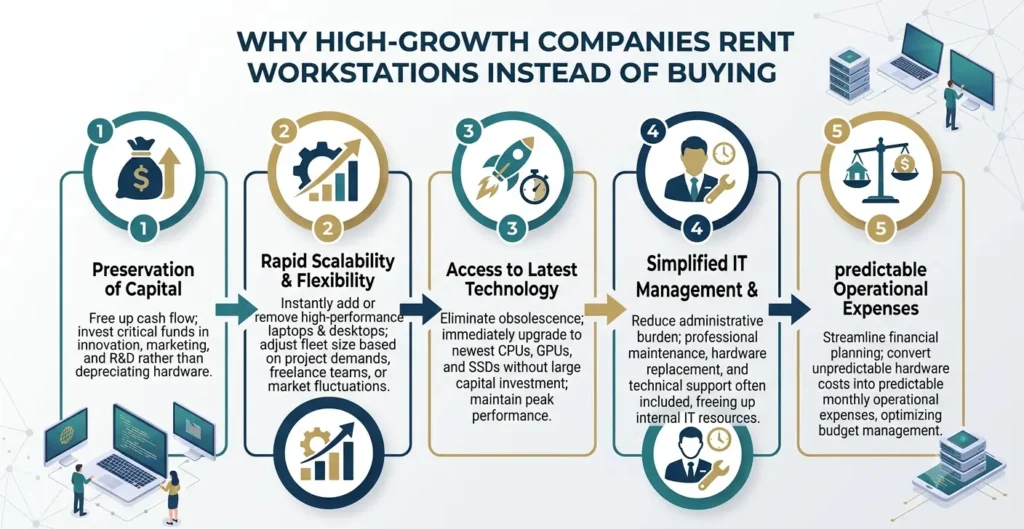
High-growth companies operate differently from businesses with stable, predictable infrastructure requirements. A growing organization may add new employees every month, enter new markets, open temporary offices, launch new projects, onboard enterprise clients, or build specialized teams with little notice. As the business expands, its technology requirements grow alongside it.
High-performance workstations can require significant upfront investment, and their value can decline as newer hardware becomes available. At the same time, a company’s requirements may change long before the equipment reaches the end of its useful life.
This is why workstation rental services are gaining attention among startups, IT companies, engineering firms, architecture practices, media agencies, research organizations, design studios, manufacturing companies, and enterprises managing project-based teams.
This article explains why high-growth companies increasingly consider workstation rentals instead of purchasing and how the model can support business expansion without unnecessarily tying up capital in hardware.
How Renting High-Performance Workstations Reduces Upfront IT Infrastructure Investment
High-performance workstations are substantially more capable than ordinary office computers. Depending on the workload, they may require powerful processors, large amounts of RAM, high-capacity SSD storage, professional displays, and dedicated graphics cards.
For a growing company, capital may be better allocated toward hiring, product development, sales, marketing, infrastructure, research, or other activities directly associated with expansion. Workstations on rent allow businesses to access the required computing capability while avoiding the need to purchase the entire hardware fleet immediately.
How Renting Workstations Supports Rapid Employee Onboarding in Growing Companies
Rapid hiring is one of the biggest challenges faced by high-growth organizations. Recruitment may happen faster than procurement. Waiting for new equipment to be purchased, delivered, configured, and deployed can delay employee productivity.
A workstation rental provider can help organizations procure additional systems according to their deployment schedule. Instead of delaying onboarding until procurement is complete, companies can plan workstation deployment alongside recruitment.
How Customizable Workstation Rentals Meet Different Business and Technical Workloads
Not every employee needs the same computer. A finance executive may require a standard business desktop, while a 3D designer may need a dedicated GPU. A software developer may prioritize CPU performance and RAM, whereas a video editor may require fast storage and graphics processing capability.
Buying equipment for every role can create a complex inventory. Rental workstations allow companies to specify configurations according to their applications.
CJPL lists workstation options with Intel Core i5, i7, i9, and Xeon processors, RAM configurations from 8GB to 64GB, storage options ranging from hundreds of gigabytes to several terabytes, displays from 15 to 32 inches, and discrete graphics options from 1GB to 16GB.
This variety allows businesses to create different workstation configurations for different departments. Instead of purchasing a high-end workstation for every employee, organizations can allocate high-performance hardware only to employees whose workloads justify it.
How Renting Workstations Reduces Hardware Maintenance and IT Support Pressure
For a growing organization, internal IT teams are often already responsible for cybersecurity, software deployment, user accounts, networks, cloud systems, data protection, and technical support.
Hardware failures can interrupt employee productivity. Replacement components need to be sourced, repairs need to be coordinated, and IT staff may need to troubleshoot systems. Adding extensive hardware maintenance can increase operational pressure.
A rental arrangement with technical support can reduce some of this responsibility. CJPL highlights technical assistance with its enterprise rental solutions and provides support for rented equipment.
How Workstation Rentals Support Hybrid Work and Flexible Business Infrastructure
Companies may operate through headquarters, branch offices, coworking spaces, remote teams, client locations, and temporary project sites. This creates a requirement for IT infrastructure that can move with the business. Rental workstations and desktops can help organizations establish temporary or flexible work environments without purchasing permanent equipment for every location.
For ownership, the calculation can include acquisition cost, installation, maintenance, upgrades, repairs, depreciation, storage, asset tracking, replacement, and disposal. For rental, organizations should consider rental charges, contract duration, configuration, maintenance coverage, replacement terms, logistics, support, and return conditions.
Computer Junction: A Strategic Workstation Rental Partner for High-Growth Companies in India
Computer Junction Private Limited is an enterprise IT and mobility rental service provider offering workstations, laptops, desktops, Mac systems, servers, networking devices, storage solutions, security equipment, and other technology infrastructure. The company’s workstation rental service is built around the idea that businesses should be able to access computing capacity according to their requirements.
Its workstation portfolio supports multiple brands and configurations, including Dell, Lenovo, HP, Acer, and customized systems. Businesses can select processors, RAM, storage, display sizes, and graphics capabilities according to their applications.
CJPL’s wider IT rental portfolio allows businesses to address different infrastructure requirements through one enterprise-oriented rental provider. The company also emphasizes quick turnaround, technical assistance, transparency, certified professionals, and PAN-India sales and support.
For high-growth organizations, this combination of configuration flexibility, broad inventory, enterprise support, and geographic reach can make workstation rental easier to integrate into a wider IT strategy.
Conclusion
Buying workstations can be appropriate when computing requirements are permanent, predictable, and unlikely to change significantly. However, rapid expansion, project-based teams, uncertain hiring plans, temporary offices, specialized workloads, and evolving technology requirements can make permanent hardware ownership less attractive.
Workstation rentals provide businesses with access to high-performance computing without requiring every system to become a long-term company-owned asset. The benefits can include lower upfront investment, easier scaling, access to customized configurations, reduced hardware-management pressure, greater flexibility for temporary projects, and the ability to align technology capacity with actual business demand.


