Modern organizations operate in highly dynamic environments. Hybrid work models, remote teams, rapid expansion, temporary projects, and evolving technology requirements have made flexibility more valuable than ever. Flexible IT solutions help companies avoid these challenges. Instead of owning depreciating assets, businesses can access updated systems according to operational needs.
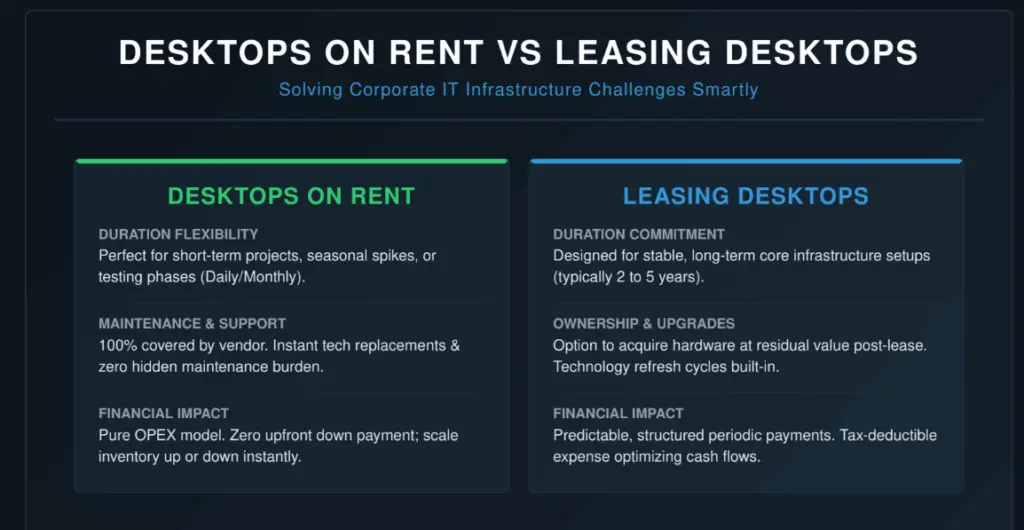
Although both models eliminate the need for large upfront purchases, they differ significantly in terms of flexibility, ownership structure, maintenance responsibilities, and contract duration.
Desktop rental is a short-term or flexible arrangement where businesses use desktop computers for a fixed monthly payment over a defined period. The ownership remains with the service provider, while the client gets access to the systems and related support services.
Desktop leasing, on the other hand, is usually a longer-term financial arrangement where businesses use computer systems for an extended period under a contractual agreement. Lease durations commonly range from two to five years depending on business requirements.
Renting desktops is particularly useful for organizations that require systems temporarily or have changing workforce requirements. Companies often choose this option for training programs, events, seasonal projects, remote workforce expansion, temporary offices, or short-duration business operations.
Leasing works well for organizations with stable workforce requirements and predictable technology usage. Companies that want long-term access to IT infrastructure without immediate full payment often prefer this model.
One of the biggest advantages of renting desktop is flexibility. Businesses can increase or decrease the number of systems according to operational requirements without making long-term commitments. It also reduces the stress associated with hardware maintenance, upgrades, and technical support because these responsibilities are generally managed by the provider.
However, leasing agreements may come with fixed terms and limited flexibility. If a company’s technology needs change significantly during the contract period, adjusting the agreement can become difficult or expensive.
Financial Benefits of Renting Desktops Instead Of Buying
One of the primary reasons businesses choose rental desktop is cost efficiency. Purchasing desktops in bulk requires significant capital investment, especially for startups and growing businesses. Renting allows organizations to access high-performance systems without disrupting cash flow.
Monthly payment structures simplify budgeting because companies know exactly what they are spending on IT infrastructure. This predictability becomes extremely valuable for businesses managing multiple operational costs simultaneously.
Another advantage is reduced maintenance expenditure. Repair costs, servicing, replacements, and technical support are often included within the rental package. This minimizes unexpected expenses and reduces dependency on internal IT teams.
Businesses also avoid depreciation losses. Purchased hardware loses value over time, whereas rented systems can be upgraded or replaced without financial complications.
Operational Flexibility for Growing Businesses
Scalability is one of the most important considerations for modern companies. Organizations experiencing growth often need additional desktops quickly to support expanding teams or new projects.
With desktop rental, businesses can increase or decrease device quantities according to operational requirements. This flexibility is especially useful for industries with fluctuating workloads, contract-based staffing, or seasonal demand spikes.
For example, educational institutions conducting examinations, BPOs onboarding temporary teams, event management companies, and IT training centers frequently require systems for limited durations. Renting provides a practical and economical solution in such situations. Leasing arrangements may not offer the same level of flexibility because contracts are usually fixed for longer durations.
Technology Upgrades and Performance Advantages
Technology evolves rapidly. Businesses relying on outdated systems may experience slower performance, reduced productivity, compatibility issues, and security concerns. Companies that purchase desktops often continue using them beyond their optimal lifecycle to maximize return on investment. Unfortunately, this can negatively affect operational efficiency.
Flexible IT arrangements solve this issue by allowing businesses to access updated systems more frequently. Providers can replace or upgrade older hardware when required, ensuring better performance and reliability.
Employees working on modern systems generally experience improved productivity, faster processing speeds, and fewer technical disruptions. This directly contributes to smoother workflows and better business outcomes.
Which Industries Benefit the Most?
Several industries benefit significantly from flexible desktop solutions. Educational institutions often require systems for examination centers, training labs, and short-term courses. Renting allows them to access large quantities of systems without heavy investment.
Corporate organizations use temporary systems during office expansions, onboarding drives, and project-based hiring. Startups benefit from reduced initial costs and improved scalability.
Event management companies, BPOs, government projects, IT training centers, and remote workforce operations also rely heavily on temporary computing infrastructure. Businesses involved in testing environments, software development, and specialized projects may require upgraded configurations for limited durations. Flexible access to desktops helps them manage these requirements efficiently.
Sustainability and Environmental Impact
Sustainability has become a growing priority for businesses across industries. Organizations are increasingly adopting environmentally responsible technology practices to reduce electronic waste and support circular economy initiatives.
Flexible IT models contribute positively to sustainability because systems are reused, refurbished, upgraded, and maintained efficiently instead of being discarded prematurely.
By extending hardware lifecycles through responsible reuse and maintenance, businesses can significantly reduce electronic waste generation while still accessing reliable computing infrastructure.
This approach supports both environmental responsibility and cost optimization, making it an attractive option for organizations focused on sustainable operations.
Why Businesses Trust Computer Junction for IT Infrastructure Solutions
Computer Junction has established itself as a trusted name in the IT infrastructure industry by delivering reliable technology solutions tailored to diverse business requirements. With years of experience in hardware solutions, enterprise support, and infrastructure services, the company understands the evolving needs of modern organizations.
One of the key strengths of Computer Junction lies in its ability to provide scalable and customized desktop rental solutions for businesses across different sectors. Whether an organization requires systems for short-term projects, corporate expansions, training environments, examination centers, or remote teams, the company offers dependable solutions backed by technical expertise and responsive support.
Computer Junction focuses on delivering quality-tested systems, timely deployment, professional maintenance services, and flexible engagement models that align with business goals. Their strong operational capabilities and customer-centric approach help organizations reduce downtime, improve productivity, and manage IT infrastructure more efficiently.
Another important advantage is the company’s understanding of sustainable technology practices. By promoting optimized hardware utilization and responsible IT lifecycle management, it supports businesses seeking cost-effective and environmentally responsible technology solutions.
For companies looking to balance performance, flexibility, and operational efficiency, it provides a dependable technology partnership that extends beyond simply supplying hardware.
Conclusion
Choosing between desktop rental and leasing depends largely on business objectives, operational flexibility, financial planning, and technology requirements. While leasing may work well for organizations with stable long-term infrastructure needs, flexible rental models offer significant advantages for businesses seeking scalability, reduced costs, easier upgrades, and comprehensive support.
As technology continues to evolve, businesses are increasingly prioritizing agility and operational efficiency over traditional ownership models. Flexible infrastructure solutions allow organizations to adapt quickly, control costs more effectively, and maintain access to updated systems without long-term financial pressure.
By carefully evaluating business requirements and partnering with a trusted technology provider, organizations can build smarter, more efficient IT strategies that support both immediate operations and future growth.

I am an accomplished author and marketing professional with strong expertise in brand promotion and digital transformation. helping businesses build powerful brand identities and expand their presence through strategic digital marketing initiatives. With hands-on experience in modern marketing tools and business digitalization.


