
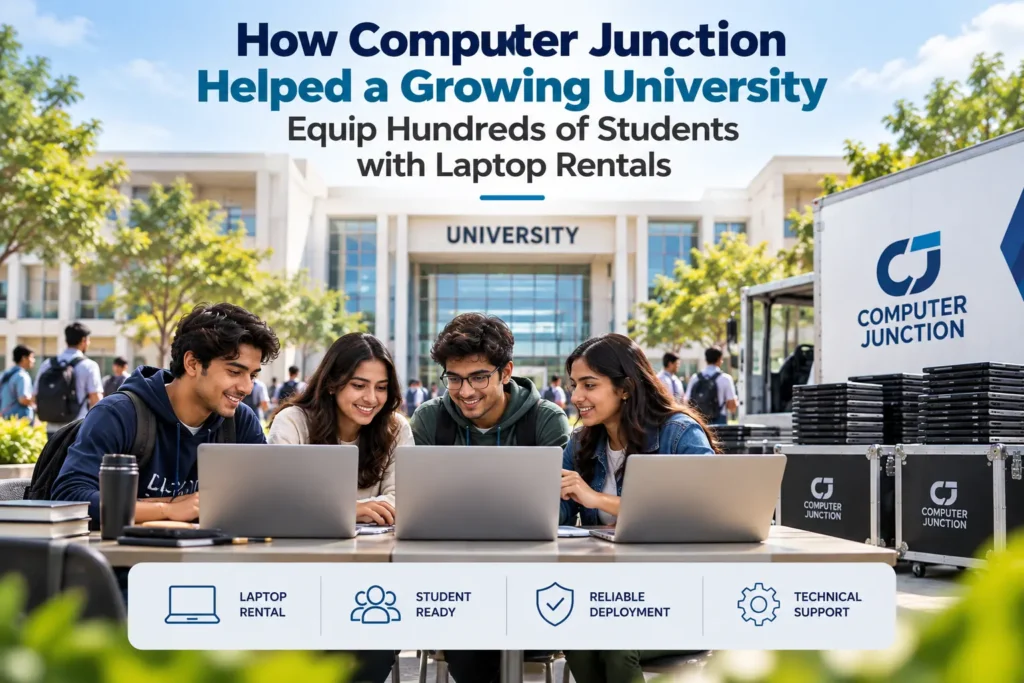
When a university expands its student base, the pressure on its IT infrastructure grows just as quickly. More students need access to laptops, software, digital learning platforms, online examinations, research resources, and collaborative tools. For many institutions, however, purchasing hundreds of laptops at once is not always the most practical approach.
This was the challenge faced by one of our university clients, a well-established and fast-growing higher education institution located in the Delhi-NCR region. Known for its expanding academic programmes, modern campus infrastructure, and strong focus on technology-enabled learning, the university caters to more than 8,000 students across undergraduate, postgraduate, and professional programmes.
The university needed to provide laptops to hundreds of students within a limited timeframe. At the same time, it wanted to avoid making a large investment in devices that could quickly become outdated or difficult to manage at scale.
The institution turned to Computer Junction for a flexible laptop rental solution that could support its immediate requirements while giving its IT team greater control over cost, deployment, maintenance, and future scalability. This case study explains how the project was approached and how laptop rentals helped the university build a more flexible technology infrastructure for its growing student community.
A Growing University Faced a Rising Need for Student Laptop Rental Solutions
The client was a rapidly developing university with a diverse student population across multiple academic programmes. Although computer laboratories were available on campus, they could not always provide the flexibility required by modern students. C
oursework increasingly involved learning management systems, digital assignments, research databases, online collaboration, presentations, coding applications, content creation, and remote academic activities. Students needed the ability to work beyond scheduled laboratory hours and access their academic resources from classrooms, hostels, residences, libraries, and other locations.
The university therefore needed a reliable student laptop rental solution that could provide hundreds of devices without requiring the institution to purchase and manage the entire fleet immediately.
Why Buying Hundreds of Laptops Was Not the Ideal Short-Term IT Strategy
The first challenge is the capital expenditure involved. Buying a large number of laptops requires a significant upfront investment. This becomes particularly important when devices are intended for short-term academic programmes, temporary student cohorts, special projects, workshops, examinations, or rapidly expanding departments.
The second challenge is technology lifecycle management. Laptop specifications continue to evolve, and devices purchased today may not remain the preferred configuration several years later. A university that makes a large technology purchase may therefore find itself managing an ageing fleet before its expected replacement cycle is complete.
There are also ongoing expenses associated with maintenance, repairs, accessories, replacements, storage, inventory tracking, and asset management. Our laptop rentals allowed the institution to convert a major upfront hardware purchase into a more manageable operational requirement while retaining the ability to scale its device fleet according to student demand.
Assessing the University’s Bulk Laptop Rental and IT Equipment Requirements
Before recommending a configuration, the Computer Junction team focused on understanding how the laptops would actually be used. Student requirements varied by course and academic activity. Some students primarily needed devices for web-based learning, documentation, presentations, communication, research, and productivity applications. Others required more capable machines for specialised software, technical coursework, programming, media-related assignments, or data-intensive academic work.
Instead of treating the entire university requirement as a single hardware category, the project was approached around practical usage needs. This helped the university avoid an unnecessary “highest specification for everyone” approach. The objective was to provide students with configurations that were appropriate for their academic workloads while keeping overall rental costs under control.
This approach is particularly useful in higher education because different departments often have very different computing requirements. A student working primarily with documents and online learning platforms does not necessarily need the same configuration as someone using engineering, architecture, design, coding, analytics, or media applications.
Selecting the Right Laptop Configurations for Different Student Requirements
Computer Junction worked around factors such as processor generation, RAM, storage, application requirements, expected usage, and the duration of the academic programme. Rather than recommending devices based purely on specifications, the emphasis was on practical performance.
For general academic requirements, students could work with business-class laptops capable of handling productivity applications, web-based research, video meetings, learning management systems, and everyday multitasking. For more demanding requirements, higher-performance configurations could be deployed where necessary.
This approach helped the university create a more balanced laptop rental fleet. It also demonstrated an important advantage of renting IT equipment: organisations can align the device configuration with the actual project or user requirement instead of permanently committing capital to a single hardware standard.
Bulk Laptop Deployment Helped the University Equip Hundreds of Students Faster
Supplying a few laptops is very different from preparing hundreds of devices for an institutional requirement. Bulk laptop rentals require coordination, inventory planning, device readiness, logistics, and delivery scheduling.
For the university, the devices needed to be made available in a coordinated manner so that students could begin using them within the required academic timeline. Computer Junction supported the bulk laptop deployment process, helping the institution manage the transition from requirement planning to actual device availability.
The ability to source and deploy multiple devices through one rental partner simplified coordination for the university’s internal IT and administrative teams. Instead of managing several individual procurement channels, the institution could work with a single provider for the required laptop fleet.
Laptop Rental Support Helped Reduce the University’s Maintenance Burden
Providing hundreds of laptops also creates a service challenge. Devices are used intensively, and technical issues can occur at any time. For an educational institution, extended device downtime can affect assignments, classes, examinations, research work, and student productivity. This is where support becomes an important component of any bulk laptop rental programme.
Computer Junction provided maintenance and technical support as part of the rental approach, helping the university reduce the administrative burden associated with individual equipment issues.
Instead of building a completely separate support process for a large temporary or expanding device fleet, the institution could rely on its rental partner for assistance. This helped its internal teams focus more on academic and institutional priorities rather than spending excessive time coordinating every hardware-related problem.
Rental Laptops Gave the University Greater Flexibility Across Academic Projects
Another benefit of the arrangement was the ability to use rented devices for different types of institutional requirements. Beyond regular student use, laptops can be needed for short-term academic projects, special workshops, conferences, examinations, faculty requirements, research teams, and temporary departments.
Buying separate devices for every short-term requirement can create unnecessary asset management challenges. With laptop rentals, universities can obtain equipment for a specific period and return it when the requirement is complete.
This creates a more flexible approach to IT equipment management and can help institutions avoid accumulating devices that are no longer required.
Business-Class Laptops Provided a Practical Balance of Performance and Reliability
For a university deploying a large number of devices, reliability is often more important than having the most premium machine available. Business-class laptop models can be particularly useful in such environments because they are designed for regular professional use and typically provide a practical balance of performance, durability, connectivity, and serviceability.
Computer Junction’s rental inventory can support organisations with a broad range of laptop configurations, allowing institutions to select devices based on their academic and operational needs. This gives universities the ability to build a more purpose-driven device fleet instead of relying on one standard configuration for every user.
For the university, Computer Junction served as a single point of coordination for the laptop rental requirement. This helped reduce the complexity associated with sourcing and supporting a large number of devices.
A centralised approach also makes communication easier when additional laptops, replacements, configuration changes, or support requirements arise during the rental period.
Why Laptop Rentals Can Be a Smart Choice for Universities and Educational Institutions
Higher education is becoming increasingly technology-driven. Students now rely on digital platforms for learning, communication, research, assignments, examinations, collaboration, and professional development. At the same time, university technology requirements can change quickly.
Laptop rentals offer institutions a way to respond to these changes without committing their entire IT budget to long-term hardware ownership. The model can be useful for universities that need bulk laptop rentals for students, temporary academic programmes, project-based requirements, training sessions, examination centres, research teams, or campus expansion.
The flexibility to hire equipment when needed, scale when demand increases, and return devices when the requirement ends can help institutions manage technology more efficiently.
Final Outcome
The university approached Computer Junction with a straightforward challenge of equipping hundreds of students with reliable laptops while avoiding the operational and financial pressure of a large-scale hardware purchase.
By combining bulk laptop rentals, configuration planning, deployment support, maintenance, replacement assistance, and scalable access to IT equipment, Computer Junction helped the institution establish a more flexible approach to student computing.
The project demonstrated that a growing university does not necessarily need to own every device it uses. With the right rental partner, educational institutions can access the technology they need, when they need it, while keeping their IT infrastructure flexible enough to respond to changing academic and student requirements.

I am an accomplished author and marketing professional with strong expertise in brand promotion and digital transformation. helping businesses build powerful brand identities and expand their presence through strategic digital marketing initiatives. With hands-on experience in modern marketing tools and business digitalization.


