
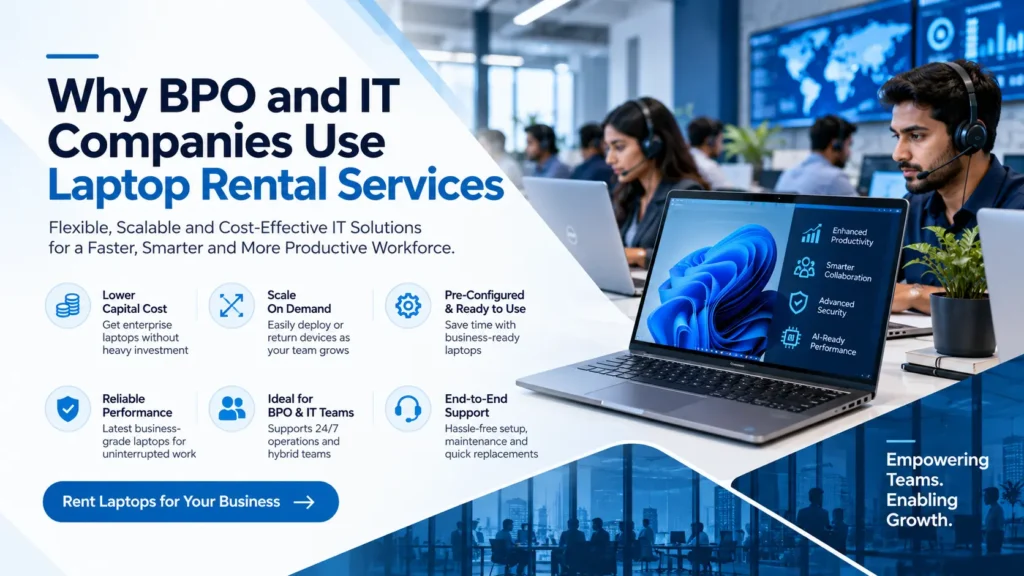
A BPO floor can go from 40 seats to 150 in a single hiring drive. An IT services company can win a project on Monday that needs 30 configured laptops by Friday. Buying hardware on that timeline ties up capital and leaves you holding depreciating assets the moment the project or the headcount shrinks again.
That mismatch between how fast people scale and how slow procurement moves is exactly why laptop rental has become the default IT strategy for BPOs and IT companies, not just a stopgap.
The IT Challenges Unique to BPO and IT Companies
BPO and IT firms don’t buy hardware the way a typical office does, because their operating model isn’t typical:
- Headcount swings fast. Seasonal hiring, new client ramp-ups, and project-based staffing mean device counts move in batches of dozens, not ones and twos.
- Ramp-down is as common as ramp-up. A contract ending or a project closing out means idle laptops sitting in a storeroom, still on the books, still depreciating.
- Specs go stale quickly. Development, QA, and data-heavy roles need current-generation RAM and processors; agents on a dialer or CRM don’t. One-size-fits-all purchasing wastes money in one direction and slows people down in the other.
- Distributed and hybrid teams need devices shipped, configured, and supported outside a single head office often across multiple cities.
Why Renting Beats Buying for BPO and IT Operations
Cost control: CapEx becomes OpEx
Renting converts a large upfront hardware purchase into a predictable monthly line item. For finance teams, that’s easier to forecast, easier to scale up or down without a fresh approval cycle, and it avoids capital getting locked into equipment that’s worth less every quarter.
Scale without a procurement bottleneck
When a rental partner already holds inventory, adding 50 laptops for a new client go-live is a matter of days, not a purchase order winding through approvals, then a wait on vendor stock.
Always-current hardware
Rental fleets are refreshed regularly, so teams aren’t stuck running five-year-old machines because replacing them wasn’t budgeted this year. That matters directly for developers and QA engineers who need the latest specs to do their jobs.
Less IT burden, not more
A rental partner typically handles configuration, delivery, and support/replacement which matters when an in-house IT team is already stretched across production support and internal projects, not just device provisioning.
No dead stock when a project ends
When a contract or seasonal hiring cycle winds down, the laptops go back. There’s no leftover inventory sitting unused, still needing to be tracked, insured, and eventually written off.
| Factor | Buying | Renting |
|---|---|---|
| Upfront cost | High (CapEx) | Low (OpEx, monthly) |
| Scaling for a new client/project | Slow (procurement cycle) | Fast (from existing inventory) |
| Idle assets after ramp-down | Yes depreciating on the books | No returned to vendor |
| Hardware refresh | Budget-dependent, often delayed | Built into the rental cycle |
| IT team involvement | Full lifecycle (procure, maintain, dispose) | Configuration and use only |
Common Use Cases in BPO and IT Companies
- New batch onboarding — dozens of identically configured laptops ready before day one of training.
- Client ramp-up — matching headcount to a new account or project without a capital request.
- Remote and hybrid agents — shipping a ready-to-work laptop directly to a new hire’s home.
- Software development and QA — higher-spec machines for the length of a project, returned when it closes. (See: advantages of renting laptops for software development.)
- Disaster recovery and business continuity — a standby pool of devices ready if primary hardware fails or a new site needs to be stood up quickly.
- Training and certification batches — short-tenure laptops for time-boxed programs. (See: bulk laptop rental for training and exams.)
What to Look for in a Rental Partner
Not every rental vendor is built for BPO/IT scale. Before signing on, check for:
- Pan-India delivery and support — especially if hiring spans multiple cities.
- Configuration flexibility — RAM, storage, and OS image matched to the role, not a single fixed spec.
- Clear SLAs — turnaround time for delivery and for replacing a faulty unit.
- Data security on return — a documented wipe process before a device goes back into rotation.
- Flexible tenure — short-term for a project, longer-term for steady-state headcount, without repapering the contract each time.
CJPL supports exactly this pattern across Delhi, Gurugram, Noida, Hyderabad, Mumbai, Bengaluru, Chennai, Pune, and Mohali configured laptops, desktops, workstations, and Macs on flexible rental terms, with devices ready for both agent-floor scale and dev-team specs.
FAQ
Is laptop rental only useful for short-term projects? No. Many BPOs and IT companies rent as their standing policy for all seats, not just temporary ones, because it keeps hardware current and avoids depreciating assets sitting on the balance sheet.
Can rented laptops be configured for developers, not just call center agents? Yes rental providers like CJPL offer tiered configurations, so a QA or development team can get higher RAM/processor specs while agent-floor seats stay on standard configurations.
What happens to company data when a rented laptop is returned? A proper rental partner wipes and resets every device between assignments as a standard part of the return process this should be confirmed in the contract before signing.
How fast can a BPO scale up laptop count for a new client win? With inventory already held by the rental partner, delivery for a batch of new seats is typically a matter of days, compared to a purchase cycle that can take weeks.
Get Started
If your BPO or IT team needs laptops that scale with hiring instead of against it, CJPL’s rental plans cover configuration, delivery, and support across nine major cities.

I am an accomplished author and marketing professional with strong expertise in brand promotion and digital transformation. helping businesses build powerful brand identities and expand their presence through strategic digital marketing initiatives. With hands-on experience in modern marketing tools and business digitalization.


